The Cutting
The rails came up off the Brantwood branch in 1964. I have the lifting certificate. I have walked that line four times a year since 1991 and I can tell you to the yard where every rail used to sit, and I can tell you that something is still running on it.
My job was earthworks. A closed line is still a liability — the cuttings slip, the culverts block, the bridges come down on footpaths — so somebody walks it twice in spring and twice in autumn with a clipboard and a probe and writes down which bits are trying to kill a rambler. For thirty-four years that somebody was me.
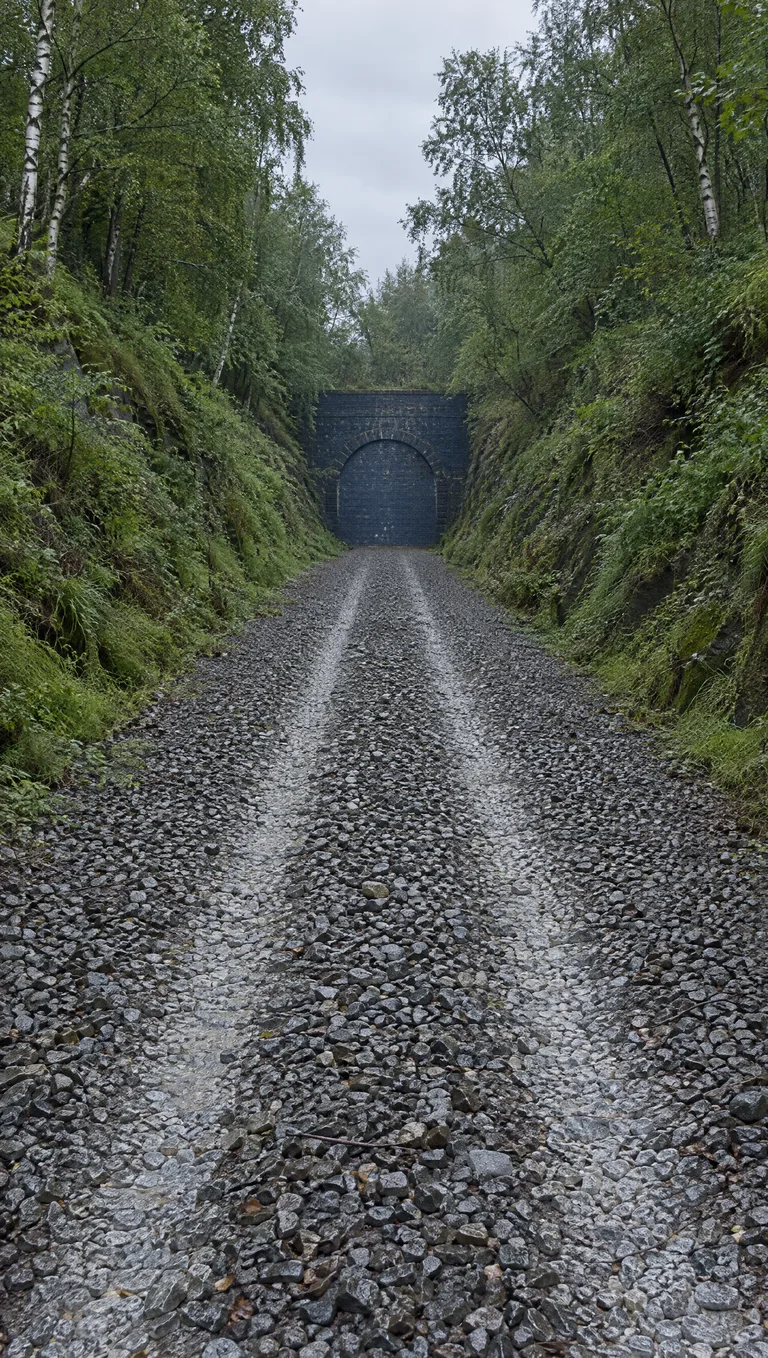
The Brantwood branch runs five and a half miles from the junction at Harpersford up to where the quarry was. Most of it is in cutting, which is why it was closed; the cuttings cost more to hold than the traffic was worth. Three bridges, two culverts, one tunnel at Mile 4, two hundred and ninety yards, bricked at both portals in 1966.
Bricked at both portals. Write that down too.
⁂
A lifted line looks like a long thin garden after sixty years. Birch and willow come in first, then ash. The ballast holds out longest because nothing much will root in it, so for the first few decades you get a clear stone track with trees either side, and then slowly the stone goes under leaf litter and you lose the formation altogether.
On the Brantwood branch the formation never went under.
I noticed it properly in about my fourth year, which tells you how unremarkable a thing it is to look at. Between Harpersford and the tunnel the ballast carries two parallel bands, about four foot eight apart, where the stone sits cleaner and brighter than the stone either side of it. Not bare. Not swept. Polished — the top faces of the chippings worn smooth and pale, the way the stone goes under a rail that has carried traffic for fifty years.
Which is exactly what it is, I told myself, for twenty years. The rails sat there from 1887 to 1964. Of course the stone under them is polished.
⁂
Here is what changed my mind, and it is not dramatic, and I would ask you to sit with how undramatic it is.
In the spring of 2011 there was a slip in the cutting at Mile 2, about four hundred tons of clay down across the formation, and I logged it, and a contractor cleared it in the August.
They cleared it down to formation level and left fresh ballast across the repair, forty yards of new grey chippings, because that is what the specification says to do.
I walked it that October. The new stone was eight weeks old.
And running through the middle of it, four foot eight apart, there were two bands where the chippings sat cleaner and brighter than the stone either side.
⁂
I did not tell the office. I want to be honest about why. I was fifty-one, I had nine years to run, and the Brantwood branch was a half-day's walk with a flask in it. A man who files a report about polished ballast is a man who gets sent for an assessment.
So instead I did what I had been trained to do, which was to measure it.
I took a profile gauge to the new stone every visit for four years. The polish deepens between March and May and does not change at all between October and February. I have sixteen sets of readings in a notebook. If you put them on a graph you get a line that climbs every spring and sits flat every winter, which is the shape of a thing that runs seasonally, and I could not make it mean anything else.
In 2015 I started marking individual chippings with a spot of blue paint, forty of them, along the polished band. Every spring the paint on the band was gone — worn off the top face, still present on the flanks. The paint on the chippings four inches outside the band stayed on for years. I have one of those stones in a drawer. The blue is still on it.
⁂
The last thing I did before I retired was walk to the tunnel with a torch, which I had done perhaps a hundred and thirty times, and look at the brickwork at the southern portal, which I had also done a hundred and thirty times.
The portal is sound. Nine courses of engineering blue, laid in 1966, no cracking, no displacement, mortar intact. I have logged it sound at every single inspection for thirty-four years and it has never once been otherwise.
The polished bands run straight up to the brick and stop at it.
They do not fade out. They do not wander. Two bright lines, four foot eight apart, running two and a half miles up the formation from Harpersford and ending flush against nine courses of engineering blue that have not been disturbed since Harold Wilson was Prime Minister.
I used to think the question was what was running on the Brantwood branch.
I have come round to thinking that is the easy question, and I was asking it the wrong way about for twenty-four years. The polish deepens in spring. It ends at a wall that has never been opened.
Whatever is wearing that stone is not getting into the tunnel.
It is coming out.
 Read next
The Thirty-First Item
A deposit form lists thirty-one items. The box contains thirty. An archivist catalogues them one at a time and finds a parish that has been keeping a parallel record of people removed from the official one.
Get the next one first
A new horror story every week, free, straight to your inbox. Subscribers read each one before it appears anywhere else.