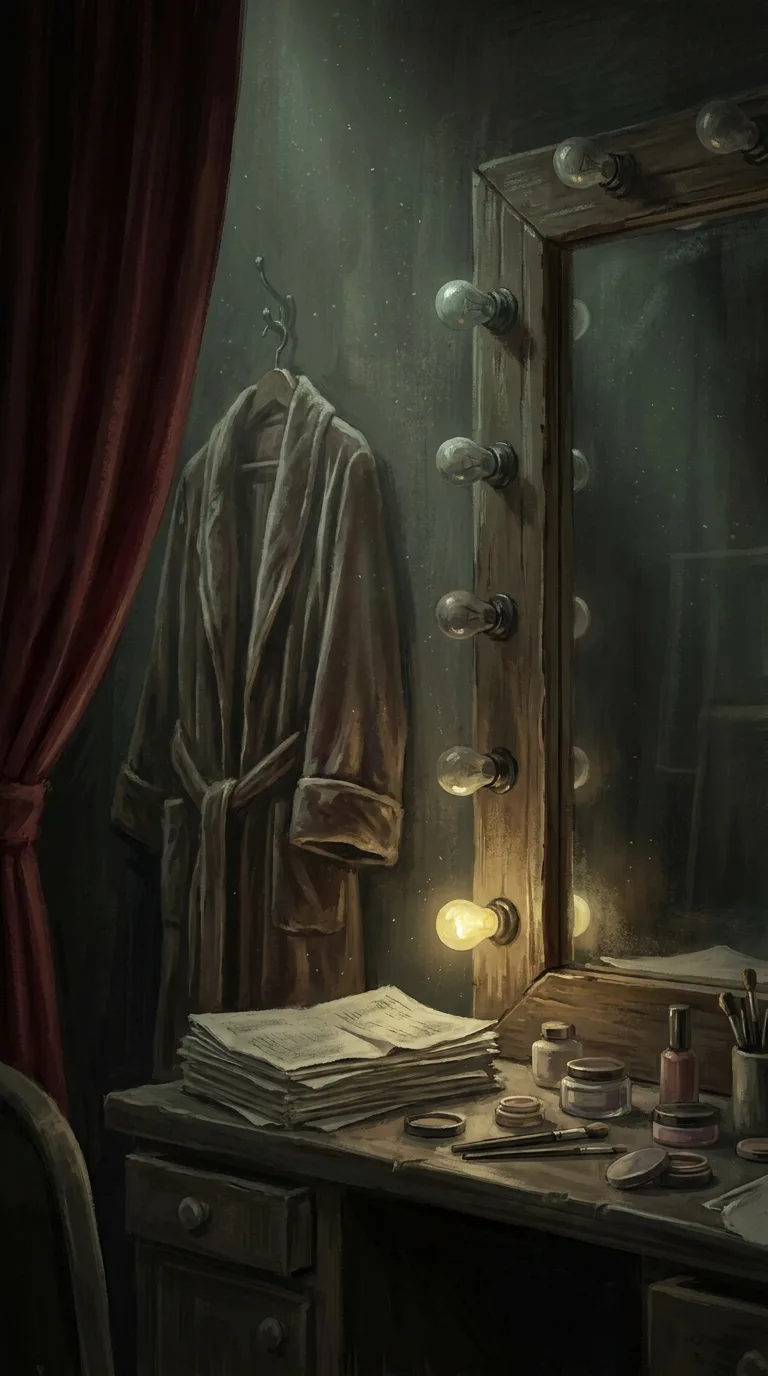
The Understudy
Corinne went home on the Tuesday with a migraine and I went on for her, and by the Friday the costume had been taken in at the waist without anybody asking me.
That is the whole story, really. Everything else is me explaining why it took eleven weeks to frighten me.
---
The play was The Sea Wife. Provincial tour, eleven venues, a company of nine. Corinne Adair had the title role and I was her cover and also played the sister, which meant that on the nights I went on for her the sister was played by the stage manager holding a script, and nobody in Scarborough ever complained.
I want to be fair about Corinne. She was not unkind to me. She was not anything to me — she was forty-eight and had done this for twenty-six years and I was twenty-nine and had done it for four, and she was pleasant in the way you are pleasant to the person who does your job when you cannot.
She went home on the Tuesday. Migraine. She had them; everyone knew.
She did not come back on the Wednesday. Or the Thursday.
By the second week the company manager had stopped saying when Corinne's back and started saying for now, and by the third week they had stopped saying anything, and I went on eleven weeks in a row, which is a whole tour, which is unheard of.
---
Nobody could reach her. I want to be clear that this was investigated, in the way things are investigated by a touring company with a get-out at eleven and a coach at seven. The company manager phoned. The producers phoned. Somebody drove to the address in Muswell Hill and there was post behind the door and no answer.
The police were involved. Actually involved, with a case number. There is a missing person report for Corinne Adair filed in the November of that year and as far as I know it is still open.
And we did the play. Eleven venues. Because that is what happens — there is no version of this industry where a tour stops.
---
The costume was the first thing.
The Sea Wife wears a green dress in the second act, and Corinne was a good deal broader than me, and for the first fortnight I wore it pinned. Then in Sheffield I came in for the half and it had been taken in properly — seams unpicked and redone, three inches out of the waist, the sort of job that takes somebody an evening.
I said thank you to Bel, who did wardrobe.
Bel said she hadn't touched it.
We had a slightly awkward conversation in which each of us tried to work out whether the other was joking, and then Bel went and looked at the seams and came back and said, in a strange flat voice, that whoever had done it had used the original thread.
I did not know what that meant. She explained: the thread on that dress was a specific green, dyed to match, bought in 2004 for the original production, and there was one reel of it, and it was in her box, and the box was locked, and there was as much on the reel as there had been.
---
Then the blocking.
There is a moment in the third act where the Sea Wife crosses to the window and puts her hand flat on the glass. Corinne did it with her right hand. I had watched her do it forty times in rehearsal and I did it with my right hand.
In Newcastle I did it with my left.
I did not decide to. I noticed halfway through the gesture, the way you notice you have driven the last three miles without attending, and I finished it and the scene carried on and afterwards I stood in the wings shaking.
I looked at the archive footage that night on my laptop. The production had been filmed in 2019 for the rights holders.
Corinne does it with her left hand.
I had been doing it wrong for eleven weeks. Every director we had, every stage manager, every actor on that stage with me, and not one of them had said a word — and the reason they had not said a word, I understood, sitting on a hotel bed in Newcastle at one in the morning, was that I had only been doing it wrong since the night I started.
---
The last thing was the line.
In the final scene the Sea Wife says: I was never coming back and you always knew it.
On the last night, in Norwich, I said: I was never coming back and you always knew it, Alice.
There is no Alice in the play. There is no Alice in the company. My name is Ruth.
I said it. I heard myself say it. The actor opposite me — Michael, who was sixty and had been doing this since before I was born — did not miss a beat, because he was sixty and had been doing this since before I was born, and he took the pause and gave me the next line and we finished the play.
Afterwards he found me in the bar and he did not ask what happened. He said: "Corinne had a sister."
I said I didn't know that.
"Died young," he said. "Long time ago. Before your time, before mine on this one." He turned his glass round. "I only know because she told me once, in a bar in Ipswich, on a different tour. Twenty years ago."
I asked what the sister's name was and he said he couldn't remember, which I do not believe, and which I have never held against him.
---
The tour ended. I did not take the transfer.
That was six years ago. I do other work now — voice, mostly, and a soap for two years, which paid for a flat. It has been a perfectly good career and I have been, on balance, happier.
I have never played that part again and I have turned down two revivals.
And there is one thing I have not told anybody, including Michael, including the police, including my husband.
In the second act the Sea Wife has a long speech about the water and she delivers it downstage, alone, and for eleven weeks I delivered it to the third row because that is where you look.
On the last four or five nights I stopped looking at the third row.
I looked at the wings, stage left, at the dark bit past the tab where the cover stands to watch, because that is where I had stood for six weeks before Corinne went home.
I do not know why I started doing it. I know it was not a choice, in the way the left hand was not a choice.
But I know what it means when the person playing a part looks at the wings, and so does anyone who has ever done this job.
It means she is checking that the understudy is watching.
 Read next
Salt and Tether
Sent to relieve a lighthouse keeper who never signed off. He is still there, entirely calm, and cannot leave.
Read next
Salt and Tether
Sent to relieve a lighthouse keeper who never signed off. He is still there, entirely calm, and cannot leave.
Get the next one first
A new horror story every week, free, straight to your inbox. Subscribers read each one before it appears anywhere else.