The Weight
The lift in my building holds eight people, and about once a fortnight it thinks there are nine.
You would not notice unless you took it alone, and most people in that building did not take it alone, because it was forty flats over eleven floors and there was always somebody going somewhere. I noticed because I worked nights.
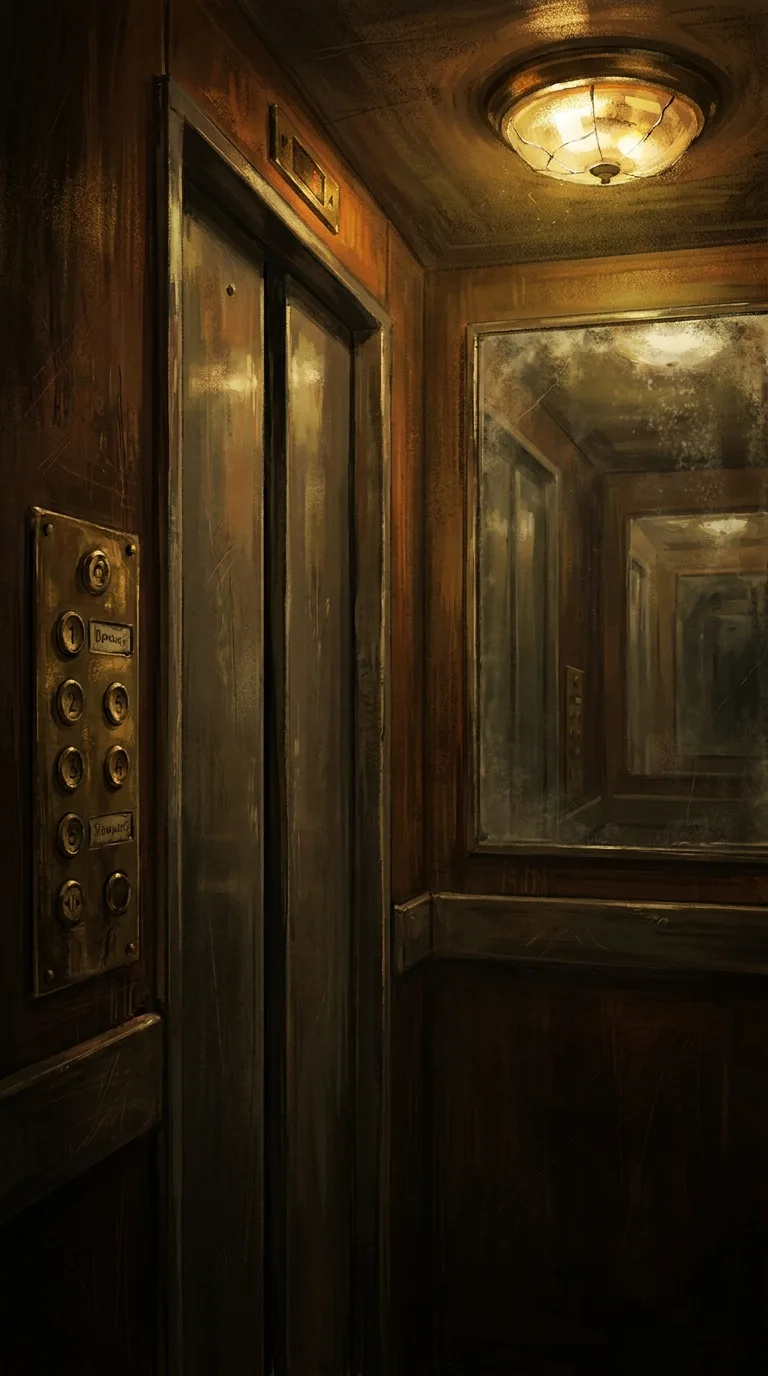
At half past two in the morning the building is as close to empty as it gets, and the lift is a small brass-buttoned box from 1961 that shudders when it starts, and there is a moment as the doors close where you feel it settle onto the cable and take your weight.
Sometimes it settled further than it should.
That is the whole of the phenomenon and I am aware of how thin it sounds written down. A slightly deeper dip. A half-inch of extra sag, the way a car does when a second person gets in. It happened perhaps twice a month for the first year and I put it down to the mechanism being sixty years old, which it was, and to being tired at half two in the morning, which I always was.
---
I want to be precise about when it stopped being nothing.
In February the lift was serviced. There is a card in a little metal frame beside the buttons with the date and an engineer's initials, and it was replaced, and underneath the new date somebody had written in biro, not on the card but on the frame itself, in the corner: 8 max. Do not exceed.
Which is what the plate says anyway. The plate says MAXIMUM 8 PERSONS 600KG, screwed to the wall in the sort of typeface that stopped being made in about 1970.
But somebody had felt the need to write it again, by hand, in biro, on the frame. And when I looked closely, there were older marks underneath — the ghost of the same note, written and cleaned off and written again, more than once, by more than one hand.
I took a photograph of it. I still have the photograph. That is the only physical evidence of anything in this entire account and it is a photograph of a warning that agrees with the sign next to it.
---
I asked Mr. Okonjo on the fourth floor, who had lived there since 1988 and was the only person I ever saw use the stairs.
"You work nights," he said. Not a question. He was watering something on his landing.
"I do."
"Then take the stairs."
I said the stairs were eleven floors and I was on the ninth and I was thirty-eight years old, not eighty.
He put the watering can down. He was not a dramatic man; he taught chemistry at a sixth-form college and he had the exact manner of somebody who is used to explaining that a thing is simply true whether or not you like it.
"When it dips," he said, "how many are in it?"
"Just me."
"Yes. And what do you do?"
"Nothing. I go to my floor."
"Good." He picked the can back up. "Keep doing nothing. Don't count."
---
I did not ask what he meant, and I have thought since that this was the single most sensible thing I did in that building, and that I only did it out of embarrassment.
Because there is nothing to count. That is the thing. You are alone in a lift. There is no possible count other than one. To count is to entertain the proposition that there might be another number, and I understood, standing on that landing with a chemistry teacher and a watering can, that this was the whole of the danger and that he had just told me so as plainly as it can be told.
So for another eight months I did nothing. The lift dipped, twice a month, three times, and I looked at the buttons and I thought about my shift and I got out on nine and it never once did anything else.
I was not frightened. I want that on record too. It became a fact about my building, like the boiler and the pigeons.
---
On the twelfth of November I got in at two forty in the morning with two bags of shopping, and the doors closed, and it dipped.
And because my hands were full and I was tired and I was thinking about whether I had bought coffee, I did the arithmetic without meaning to.
Two bags. Maybe six kilos. Not enough. The dip was the deep one, the second-person one, and I had six kilos of shopping and a coat and I knew — the way you know your own weight without checking — that it did not account for it.
And in the half-second where I understood that I had just worked out that there was more in the lift than there should be, the light changed.
Not flickered. It got slightly warmer, the way a room does when somebody turns a lamp on in the next room and you catch the edge of it. And the small brass panel by the door, which had reflected exactly one person for two years, reflected the shape of one and a half.
I got out on the fourth floor.
I did not press the button. The lift stopped at the fourth floor, and the doors opened, and Mr. Okonjo's landing light was on, and I walked out and stood in the corridor with my shopping and the doors closed behind me and the lift went up to nine without me.
---
I moved out in January. I told the letting agent it was the damp.
Mr. Okonjo helped me get the sofa down the stairs, all eleven flights, and neither of us said anything about it until the last landing, when he put his end down and straightened up and said, "You counted."
"Yes."
"Did you look?"
And I said yes, and he nodded slowly, and then he said: "Then you were lucky, and you were lucky because you got out at four."
"Why four?"
"Because I have lived here thirty-seven years," he said, "and I keep my landing light on all night, and everybody who has ever counted in that lift has got out on my floor, and every single one of them has been able to." He picked up his end of the sofa. "That is the only thing I know about it. That is all thirty-seven years has bought me."
---
I live in a two-storey building now, with no lift, and I have not thought about it seriously in three years.
But I have never been able to lose one detail, which is the biro on the frame.
Because the note said 8 max. Do not exceed. And I understood it, for two years, as a warning about overloading a sixty-year-old mechanism.
It has since occurred to me that it might not have been addressed to us.
 Read next
Tenant's Handbook
Clause 14.3 of the tenancy agreement concerns the fourth bedroom. The flat has three.
Read next
Tenant's Handbook
Clause 14.3 of the tenancy agreement concerns the fourth bedroom. The flat has three.
Get the next one first
A new horror story every week, free, straight to your inbox. Subscribers read each one before it appears anywhere else.