Correspondence
The seventh letter arrived on a Tuesday and answered a question I had not asked anyone.
I should explain about the letters, because the arrangement was unusual even before it became impossible.
Ruth and I were pen-friends for thirty-one years. Not friends who wrote — pen-friends, specifically, in the old sense: we were paired by a scheme in 1994 when we were both nineteen, she in Fife and I in Somerset, and we wrote to each other every three or four weeks for three decades and never once met. It was not for want of opportunity. It became, quite early on, the point. There is a particular honesty available to someone who will never have to look at your face.
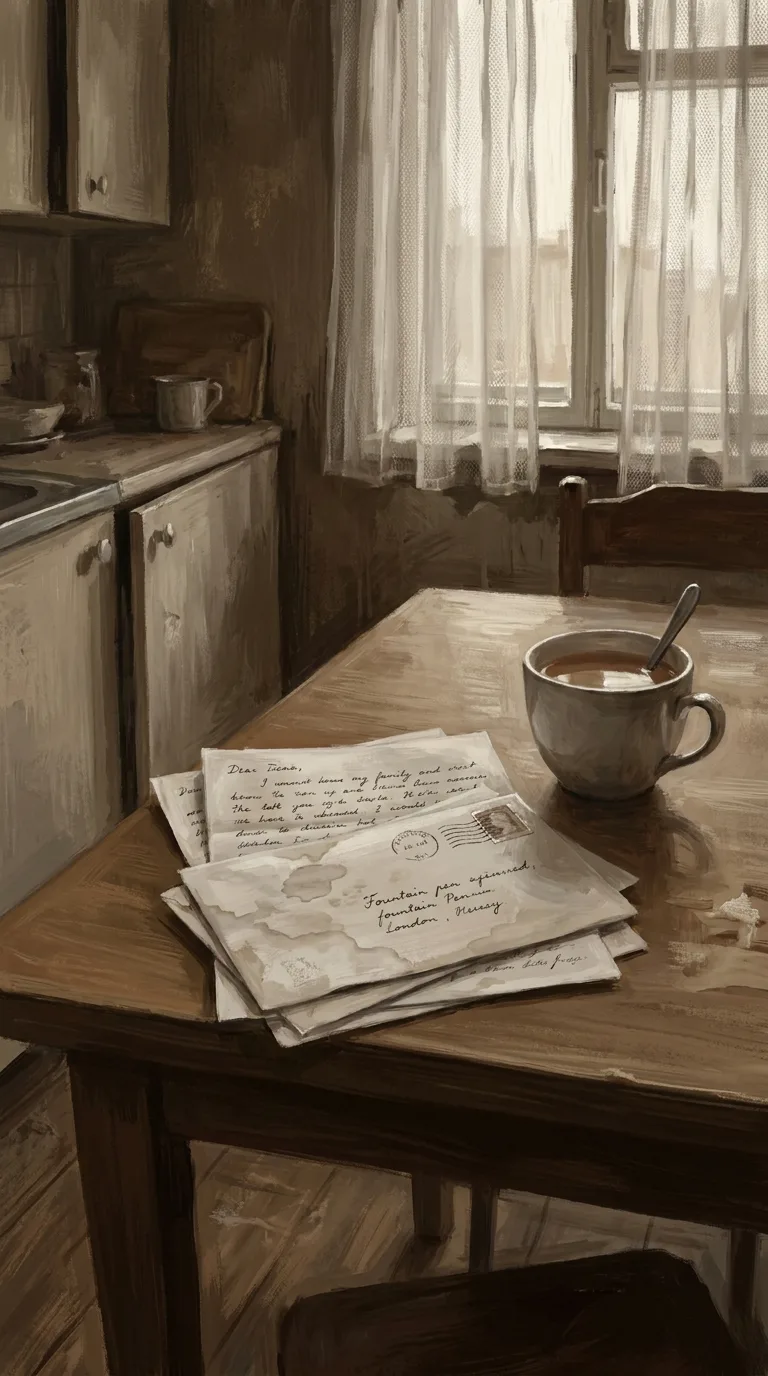
She wrote in fountain pen on Basildon Bond and she never dated her letters, which infuriated me for the first ten years and which I came to understand as a kind of gift — you could not tell from a Ruth letter whether it had been written the previous evening or six weeks ago in a bad mood, and so you had to take it as it came.
She died in March. Her daughter phoned me, which was kind and must have been strange, since I was a name in an address book and thirty-one years of envelopes in a box.
I wrote back to the daughter. I said the true thing, which is that I had loved her mother and had no idea what her voice sounded like.
---
The first letter after that came in April.
I assumed, for perhaps ninety seconds, that it was one she had posted before she died and that the Royal Mail had done what the Royal Mail occasionally does. That is a completely reasonable assumption and I held it comfortably.
It was about her garden. It said the blackbird was back and that she had lost the argument with the bindweed. It said she hoped my knee was better.
My knee had started hurting in February. I had told her about it. Fine.
The second came three weeks later and mentioned that the mornings were getting lighter, which they were, and asked whether I had made a decision about the flat.
I had not told her about the flat. I had not told anyone about the flat, because there was nothing to tell — I had looked at a two-bedroom in Wells in the first week of April and had not mentioned it to a living soul because I had not decided anything and did not want to be talked out of it.
I sat with that letter for a long time.
Then I did what I think most people would actually do, whatever they say afterwards. I checked the postmark. It was current. I checked the handwriting against the box. It was hers, and it was not close-but-not-quite; it was hers, including the way she made a lower-case g like a figure eight that had given up halfway.
And then I wrote back.
---
I want to be honest about the next part, because this is where people's sympathy usually stops.
I did not investigate. I did not contact the daughter, or the police, or a graphologist, or whatever a sensible person is supposed to do. I wrote back, and I put it in the post box at the end of Coombe Lane, addressed to the house in Fife where a dead woman had lived, and I did it every three weeks for six months, and it was the happiest I have been since my husband died.
She wrote about her garden and the weather and a programme she had seen. She asked after my sister by name. She was, in every way I could measure, Ruth: the same slightly barbed kindness, the same refusal to date anything, the same inability to end a letter without a postscript.
The only difference — and it took me four letters to notice it — was that she never referred to anything I had written.
Not once. She answered questions. She just answered ones I had not asked.
The flat. My knee, before I mentioned it. In June she wrote I think you're right about not going to the memorial, don't let them make you, three days before I decided not to go, and the letter was postmarked before the invitation arrived.
---
The seventh letter came in October.
It said:
I know you've been wondering whether it's really me. You've been wondering it since April and you've never once put it in a letter, which is very like you. I don't know how to answer it. I don't know what I am now. I only know that I still have the habit of you.
Don't ask me anything about it. I don't think I could bear to find out that I don't know.
R.
P.S. The bindweed has won.
---
I have not stopped writing.
There is a great deal of advice available about grief and none of it covers this, and I have decided that is my own business. She was my friend for thirty-one years and I never saw her face, and the arrangement we had — a voice on paper, arriving from somewhere I could not go — has not actually changed in any way I can point to.
I am seventy-two. My knee is worse. The flat in Wells fell through and I did not mind as much as I expected.
Last week I wrote to tell her that I had finally read the book she recommended in 2011 and that she had been right about it, which I had been putting off admitting for fourteen years.
And I sat there for a while with the pen in my hand, and then, at the bottom, under my name, I wrote:
P.S. When you say you have the habit of me — is it only the habit? Or is there anything of you in it?
I posted it on Thursday. That was eleven days ago.
Nothing has come.
Thirty-one years, and she never once took longer than three weeks, and I asked her the one thing she told me not to, and I have to live now with the fact that I could not leave it alone.
I keep checking the box on the gate. I know how this looks.
But I think about that postscript — I don't think I could bear to find out that I don't know — and I understand that I did not ask a question.
I gave her something to find out.
 Read next
The 3:04
A night-shift camera operator logs the same car passing an empty fell road at four minutes past three every night for eleven months — until the night it doesn't come, and she goes looking for why.
Read next
The 3:04
A night-shift camera operator logs the same car passing an empty fell road at four minutes past three every night for eleven months — until the night it doesn't come, and she goes looking for why.
Get the next one first
A new horror story every week, free, straight to your inbox. Subscribers read each one before it appears anywhere else.