Low Tide
You have three hours to cross and you must not be on the sand when the tide turns. Everyone tells you this. Nobody tells you why it matters more on the way back.
I came out to Wrackholm in October to catalogue a library. There is a house on the island with four thousand books in it, left to a trust by a man who had collected them and read perhaps forty, and the trust wanted to know what it owned before it decided what to sell. It was a fortnight's work and they were paying properly and there was a cottage.
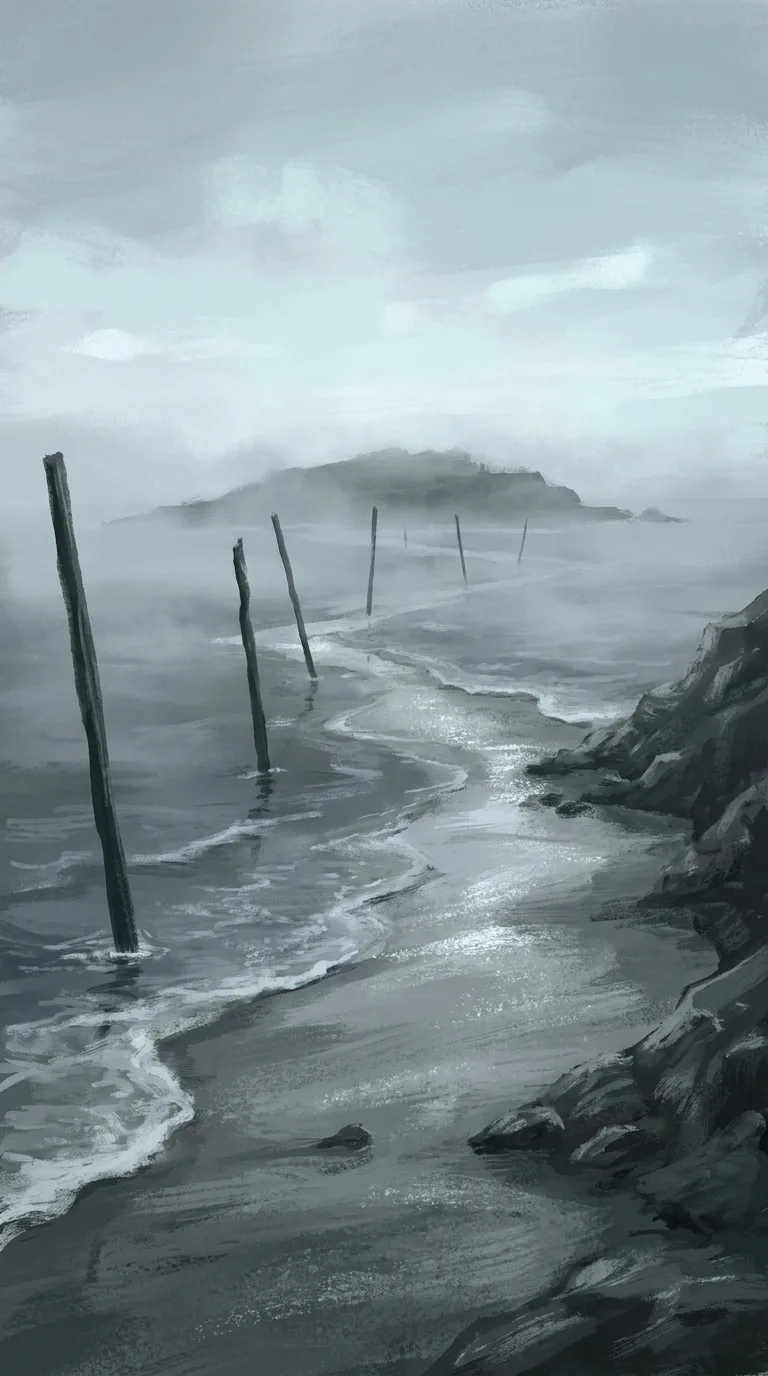
The causeway is two miles of wet sand with marker poles at intervals, and a timetable pinned up at both ends in a perspex case. Safe crossing, it says, and then two columns of times. The times change every day. You are meant to check them every day.
Mrs. Ardill, who kept the shop and the post and the crossing times, went through it with me on the first morning as though I were a child, which I did not mind.
"Three hours either side of low water," she said. "You'll see the poles. If the water's reached the third pole you've left it too late and you turn round."
"Turn round which way?"
"Whichever way's nearer." She said it flatly, and then she looked at me properly for the first time. "Coming back, mind. Coming back you don't turn round at all. Coming back you keep walking."
I said that seemed like the opposite of sensible.
"It is," she said. "Do it anyway."
---
I crossed eleven times in the first nine days and nothing happened, and I got the particular arrogance of someone who has been warned about something that then does not occur. I stopped checking the times on the board and started checking them on my phone, which is the same information, and then I stopped checking them at all in the mornings because I knew roughly what they were doing — sliding forward about fifty minutes a day, the way tides do.
Which is how, on the tenth evening, I came off the island forty minutes later than I meant to.
It was not dangerous. I want to be clear about that, because I have told this badly before and people assume I nearly drowned. The water was around the second pole when I started and it does not come in fast on that stretch; it comes in wide, from both sides, sheeting over the flats rather than rising. You do not get swept away. You get, at worst, wet to the knee and embarrassed.
I was about a third of the way across when I heard someone behind me.
Footsteps in shallow water have a very particular sound and there is no mistaking it for anything else. Not close — sixty, eighty yards back. Somebody else who had left it late.
I did what you would do. I stopped and turned round to see if they were all right.
There was nobody there.
The flats out there are almost perfectly level and there was still light in the sky. I could see the better part of a mile back toward the island, the poles going away in a line, the shine of the water. There was nothing on it. No figure, no boat, no bird.
I stood and listened, and after perhaps four seconds the footsteps started again.
Still behind me. Still eighty yards back. Coming on at a walk.
---
I turned and I kept walking, and I would like to say that was courage but it was Mrs. Ardill's voice, flat, in my head: coming back you keep walking.
It followed me for a mile and three quarters.
Not gaining. Not falling behind. It matched me, which is the part I cannot put down — when I sped up, the interval did not close, and when I slowed, it did not close either, and once, near the end, I stopped dead without warning to test it, and it stopped too, a half-second late, like a person who has been watching your back and not your feet.
The water was around my ankles by then and my boots were full and I was crying in the way you do when your body has decided the situation is serious and hasn't consulted you. I kept my eyes on the mainland slip and I counted the poles down and I did not turn round again.
At the slipway the footsteps stopped. Not gradually. They came up to the edge of the hard standing and they stopped, the way a dog stops at a gate it knows about, and I stood on wet concrete with the sea behind me and there was nothing there at all.
---
Mrs. Ardill gave me a towel and a whisky and did not ask.
When I could talk I said: "You knew."
"I told you what to do and you did it," she said. "That's the whole of it."
"But what is it?"
And she thought about that for a long moment, and then she said something I have turned over for four years.
"When you go out there you're walking on the bottom of the sea," she said. "It's only lent to you. Three hours either side. And there's things out there that are on the bottom of the sea all the time." She topped up the whisky. "They don't mind you crossing. You're allowed. That's what the poles are for — they mark the road, and if you're on the road at the proper time nothing has any argument with you."
"I was late."
"You were late," she agreed. "So you weren't on the road. You were just on the sea bed, walking, same as them." She sat down opposite me. "And out there, if you meet something and you turn and look at it, you've stopped. And if you've stopped, you're not crossing any more. You're just somewhere. And whatever it is can take its time deciding what you are."
I said that made no sense.
"No," she said. "It doesn't. But it's true, and it's been true since before there was a shop here for me to keep, and every single person on this coast knows it and not one of us can tell you why."
---
I finished the catalogue. Four thousand and eleven volumes, of which the trust sold six hundred, and I have never been asked back and I have never asked to go.
I check tide times now with a kind of religious care. Not just on causeways. On any beach, anywhere, before I put a foot on sand — I have the app and I have a paper backup and my sister thinks it is a phobia and I let her think that, because the alternative is explaining.
And there is one thing I have never told anyone, which I will put down here because I am tired of carrying it.
When it stopped at the slipway, in that half-second before I understood that I was safe, I heard it exhale.
Not a growl. Not a sound an animal makes. The small, tired, entirely human breath of somebody who has walked a long way with someone, right to their door, and now has to turn round and walk all the way back.
 Read next
The Winter Gardener
She hires a man to restore a walled garden that hasn't grown anything in forty years. He already knows why.
Read next
The Winter Gardener
She hires a man to restore a walled garden that hasn't grown anything in forty years. He already knows why.
Get the next one first
A new horror story every week, free, straight to your inbox. Subscribers read each one before it appears anywhere else.