The Winter Gardener
Forty years and nothing had grown in it, and the first thing he said, standing at the door in the wall, was: "Have you eaten anything from in here?"
I said there was nothing in here to eat.
"That isn't a no," he said.
---
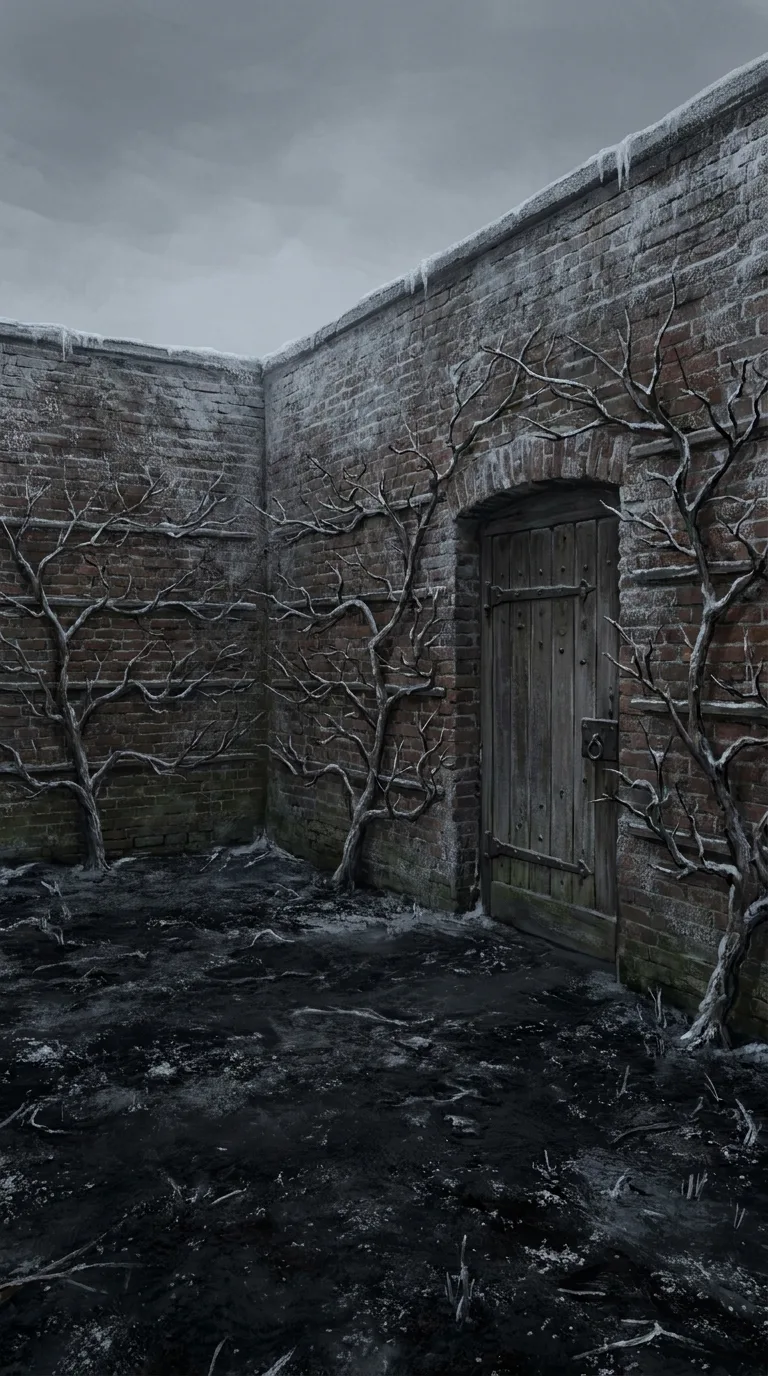
The house came with eleven acres and a walled garden, and the walled garden was the reason I bought it. Two hundred feet by ninety, eighteenth-century brick, espalier wires still stapled to the south wall and the dead armatures of pear trees still tied to them, black and hard as iron.
Inside: nothing. Not overgrown — that would have been ordinary, and I had budgeted for ordinary. Bare. Black soil, perfectly bare, in November and again in April, and when I put a spade in it the soil was beautiful, deep and dark and friable, the sort of soil people spend twenty years making.
The estate agent had described it as a project. The surveyor had written walled garden — unproductive, which I thought at the time was a strange thing to write about a garden.
I advertised for a gardener in the county paper and got four replies, three of which were landscaping firms wanting to put in decking.
The fourth was a postcard. It said: I know the garden at Thelney. I will come Thursday. Do not plant anything before I do. No name, no number.
---
His name was Aldous Mear, which I assumed was a joke until I saw it on a bank transfer.
He was somewhere past sixty and built like a man who had done physical work his whole life without ever going to a gym, and he came Thursdays and Sundays and would not take a day rate, only a monthly figure, which he named and which was low.
He would not come in the house. This became a running argument that lasted a year and a half and that I eventually understood was not stubbornness.
"You said you'd never eaten anything from in here," I said, in the third week.
"I said you hadn't."
"Have you?"
He was tying in a new whip against the south wall, and he took his time with the knot. "Once," he said. "Long time ago. Before I knew better."
---
Here is what he told me over two winters, in pieces, always outdoors, always while doing something else with his hands.
That the garden was not barren. That it was withholding, which he said the way you would say a person was withholding — as a description of an attitude rather than a condition.
That it had been productive until 1983.
That in 1983 the family who owned Thelney had done something in it — he would not say what, and I stopped asking after the fourth time — and that the garden had not produced since, and that this was not a punishment of them, because they were all dead, but a policy.
"Gardens are old," he said. "Not this one. The idea. You put a wall round a piece of ground and you agree with it. You give it work and it gives you food. That's the arrangement and it's older than any wall standing." He tamped soil around a root with his boot. "This one had its side of the bargain broken. It's not obliged to keep going."
I said that a garden could not be obliged to anything, and he said, "No," and carried on working, and that was the closest we came to a fight.
---
He got things to grow.
Not much, and not fast. In the second spring there were leaves on two of the pears, and in the third autumn there were eleven pears on them, small and hard and perfect.
He picked them all and burned them.
I came out and found him at the incinerator with the tray in his hands and I shouted at him, properly shouted, in a way I had not shouted at anybody since my marriage, and he stood and took it and then he said:
"It's the first thing it's offered in forty years. You don't take the first thing."
"Why not?"
"Because then you've accepted." He put the last of them in. "It's not offering you fruit. It's opening negotiations. And I've told you what happened to the last people who negotiated."
---
I am aware of how this reads.
I am fifty-four, I was recently divorced when I bought the house, and I spent three years having intense conversations with a taciturn man in a walled garden about whether it liked me. I have a sister who has made all of these observations at length.
But I would like to put down, plainly, that I was not deluded and I was not lonely in the way she means, and that what happened between us was slower and stranger than that.
We worked. That was the whole of it, for three years. He came Thursdays and Sundays and I worked beside him because it was my garden and I am not decorative, and we talked about soil and rootstock and the weather, and about once a month he said something that would keep me awake.
And in the fourth spring he came on a Wednesday, which he had never done, and he stood at the door in the wall and did not come through it, and he said: "It's offered again."
I went and looked. Where the old asparagus bed had been there were spears coming up, forty or fifty of them, in ground I had not touched.
"Do we burn it?"
"No," he said, and his voice was wrong. "You can burn fruit. Fruit's a gift. That —" he pointed, not going nearer — "is a bed. That's ground put back into use. That's not an offer. That's it starting work."
I said I did not understand the difference.
He said: "It means it's stopped negotiating with you." And then, after a moment: "It means it's decided."
---
That was two years ago.
The garden produces now — properly, absurdly, more than one household can eat. I give a great deal away. The village takes it without comment, which I found strange until I understood that everyone over sixty in that village knows exactly what Thelney is and has decided, collectively and without ever discussing it, that the polite thing is to eat the courgettes and say nothing.
Aldous comes Thursdays and Sundays. He is sixty-eight now and slower on the ladder and I do the high work.
He has never eaten anything I have grown. Not once, in five years, and I have stopped offering, because I asked him about it properly last summer and he told me the truth.
He said that in 1979 he had been eighteen and working at Thelney for the family, and that he had eaten a pear off the south wall on a hot day without thinking about it, the way you do.
He said that is why he knows the garden and the garden knows him.
He said that is why he cannot come in the house, and cannot take a day rate, and cannot leave, and has not aged the way his brothers did.
And then he said the thing I think about every single morning when I unlock the door in the wall.
"I don't regret it," he said. "That's what nobody understands. Fifty years, and I've never once regretted it, and I've never been able to work out whether that's because it was the right thing to do."
"Or?"
"Or because not regretting it," he said, "was part of what I agreed to."
 Read next
Something Owed
She inherits a house and a debt contracted in 1806. The creditor is patient, courteous, and increasingly present.
Read next
Something Owed
She inherits a house and a debt contracted in 1806. The creditor is patient, courteous, and increasingly present.
Get the next one first
A new horror story every week, free, straight to your inbox. Subscribers read each one before it appears anywhere else.