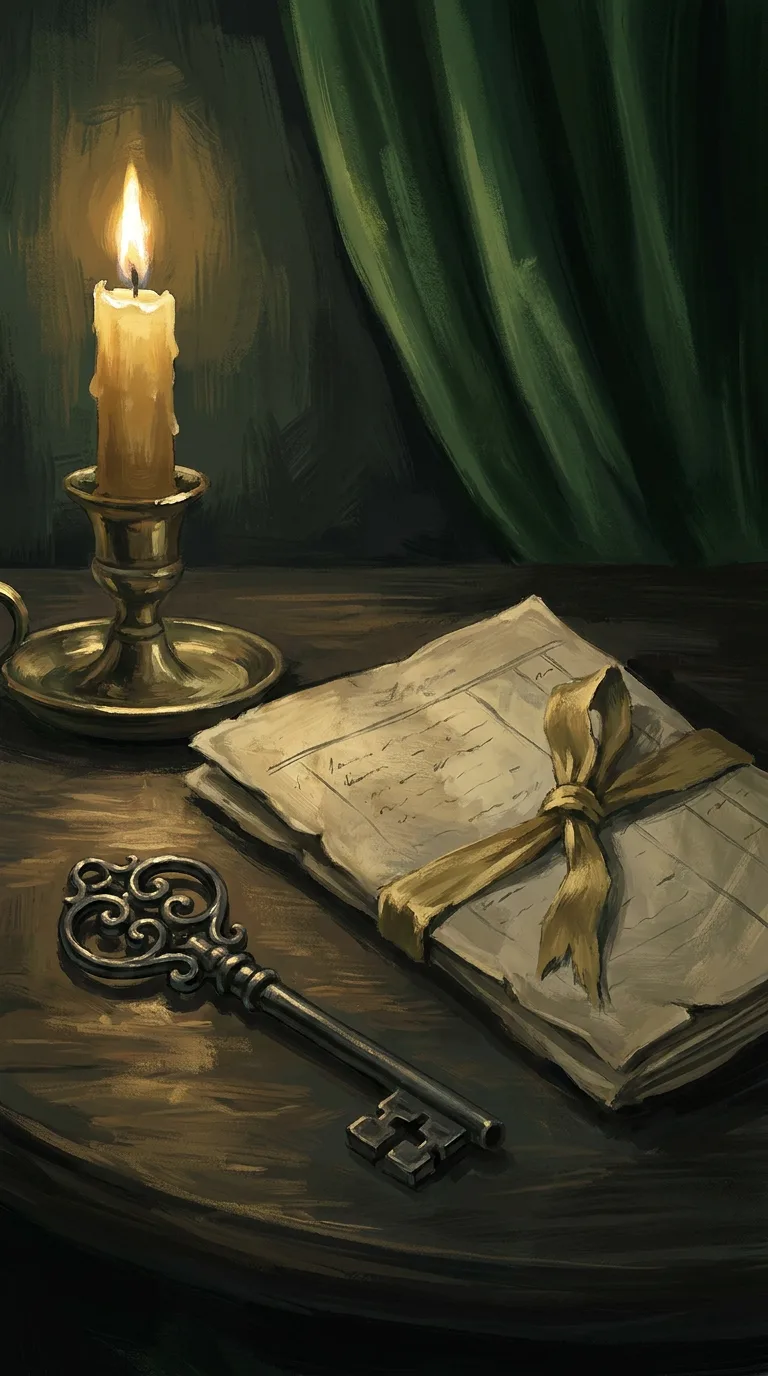
Something Owed
He came to the door on the first evening, and I want it on record that he knocked.
I had been in the house four hours. It was my grandmother's and then my mother's and now, through a sequence of deaths I had not been consulted about, mine — a narrow stone thing at the end of a lane in the wrong part of Cornwall, damp in the walls, and a kitchen that had last been modernised when modernising meant a Formica table.
The knock came at twenty past nine, and I had not heard a car.
He was perhaps thirty-five, or looked it, and he was dressed like a man who had been to a funeral and then walked a long way from it. Dark coat, no tie. Wet at the shoulders though it had not rained. He was extremely good-looking in the way that stops being a compliment and becomes a piece of information.
"Miss Trevanion," he said. Not a question.
"It's Ms. And it's Hale. Trevanion was my grandmother."
"Yes," he said, and something in his face changed very slightly, the way a man's face changes when a long-standing arrangement has just been confirmed. "That's the difficulty."
---
He would not come in. I offered — I offered twice, which I have thought about a great deal since — and both times he declined with real courtesy, as though I had offered him something expensive that he could not afford to accept.
"I'd rather explain from here," he said. "It's cleaner."
"Explain what?"
"There is a debt on this house. It is not a mortgage and it is not money and it is not, I'm afraid, negotiable in the ordinary sense." He said it the way a solicitor says a thing he has said many times and has stopped enjoying. "It was contracted in 1806 and it has been serviced by six generations of your family, and the last payment was made by your grandmother in 1997, and it is now nine years overdue."
I said, because what else do you say: "My mother owned this house for eleven years."
"Your mother," he said, "did not answer the door."
---
I looked him up. Of course I looked him up. I spent the following three days doing what any reasonable person does, which is assemble evidence that the impossible thing is a scam, and I was extremely good at it and I found a great deal.
I found the 1806 conveyance in the county record office, and there is a clause in it. It is not written in anything sinister; it is written in the flat, appalling language of property law, and it says that the tenement and its appurtenances are conveyed in consideration of the covenant hereinbefore recited, and the covenant hereinbefore recited is not recited anywhere. There is a gap in the document. Not a missing page — the pagination is continuous. A gap where a covenant should be, and the words hereinbefore recited pointing back at nothing.
I found six Trevanion women in the parish registers, one per generation, each of whom lived in that house and none of whom married.
And I found my grandmother's diary, in a box in the roof, and the entry for the fourteenth of September 1997, which says in her small firm hand: He came. I answered. Settled for another turn. God forgive me, I am tired and I have told Elizabeth nothing because I want her to have a life.
Elizabeth was my mother.
Who did not answer the door for eleven years.
---
He came back every evening for a month, at twenty past nine, and he never once knocked twice.
We talked on the step. I found out, in pieces, that he did not know what he was either — that he had been doing this for a very long time and could not remember agreeing to it, and that he had a name he no longer used because the last person who had used it was dead. He was funny about it, which I was not expecting. Bleakly, tiredly funny, in the way of someone who has had two centuries to find the joke.
He asked about my life and listened to the answers. He knew the house better than I did and told me where the joists were rotten. On the eleventh evening it was cold and I brought two cups of tea out and sat on the step beside him and he held his without drinking it, and when I asked why he said, quite simply, "Because I would like to be the kind of thing that could."
I am not going to pretend I did not know what was happening to me. I was forty-one and I had been divorced for six years and I was falling in love with a debt collector on my own doorstep, and I could see it happening the way you can see a wave coming and still not move.
---
On the last evening of the month he did not sit down.
"I have to ask you formally," he said. "That's how it works. I've put it off and I'm not permitted to put it off past a month."
"Ask me what?"
"To settle." And then, because I did not answer: "It isn't money. It has never been money. What was pledged in 1806 was continuance — a Trevanion woman in this house, in each generation, for as long as the house stands. That's all. That's the whole covenant. Live here. Don't leave. Have a daughter or don't, but if you don't, the debt falls in and the house comes to us and I would very much rather it didn't."
I said: "That's it? That's the terrible bargain? Stay in the house?"
"Yes," he said. "For your whole life. In a damp cottage at the end of a lane, forty minutes from anywhere, alone or not as you choose, until you die in it." He looked at the door frame rather than at me. "Six generations. Not one of them married. It isn't that we forbid it. It's that nobody stays."
And then he said the thing I have not been able to put down.
"Your grandmother settled in 1997 because she was tired and it was easier than the alternative. Your mother refused by never opening the door, which is its own kind of courage, and she died in Plymouth in a flat she hated. I have watched this for two hundred years and I have never once been able to tell any of them which was the right answer."
---
That was in November. It is now March.
I am still here. The joists are being done properly, which is costing more than the house is worth, and I have a job I can do from the kitchen table, and my sister thinks I have had some kind of episode and has stopped asking.
He comes at twenty past nine. He does not knock any more, because he does not have to; I leave the door open and he sits on the step and I sit inside the frame, and we have not touched and I do not know whether we can, and there is a version of my life where that is unbearable and this is not that version.
I have not settled. He has not asked again — he says he is not permitted to, that once a generation is the whole of his authority, and that as long as I neither accept nor refuse we are in a condition he described as arrears, which he said with something I chose to read as hope.
So we are in arrears. Both of us.
And every evening at twenty past nine I sit in the doorway of a house I never wanted, in a bargain nobody can explain to me, across from something that has waited two hundred years to be offered a cup of tea it cannot drink.
I am aware of what this is. I have thought about it for four months and I have decided.
Let it stay overdue.
 Read next
The Understudy
She covers a role for an actress who never comes back. The part begins to fit far too well.
Read next
The Understudy
She covers a role for an actress who never comes back. The part begins to fit far too well.
Get the next one first
A new horror story every week, free, straight to your inbox. Subscribers read each one before it appears anywhere else.