Made Good
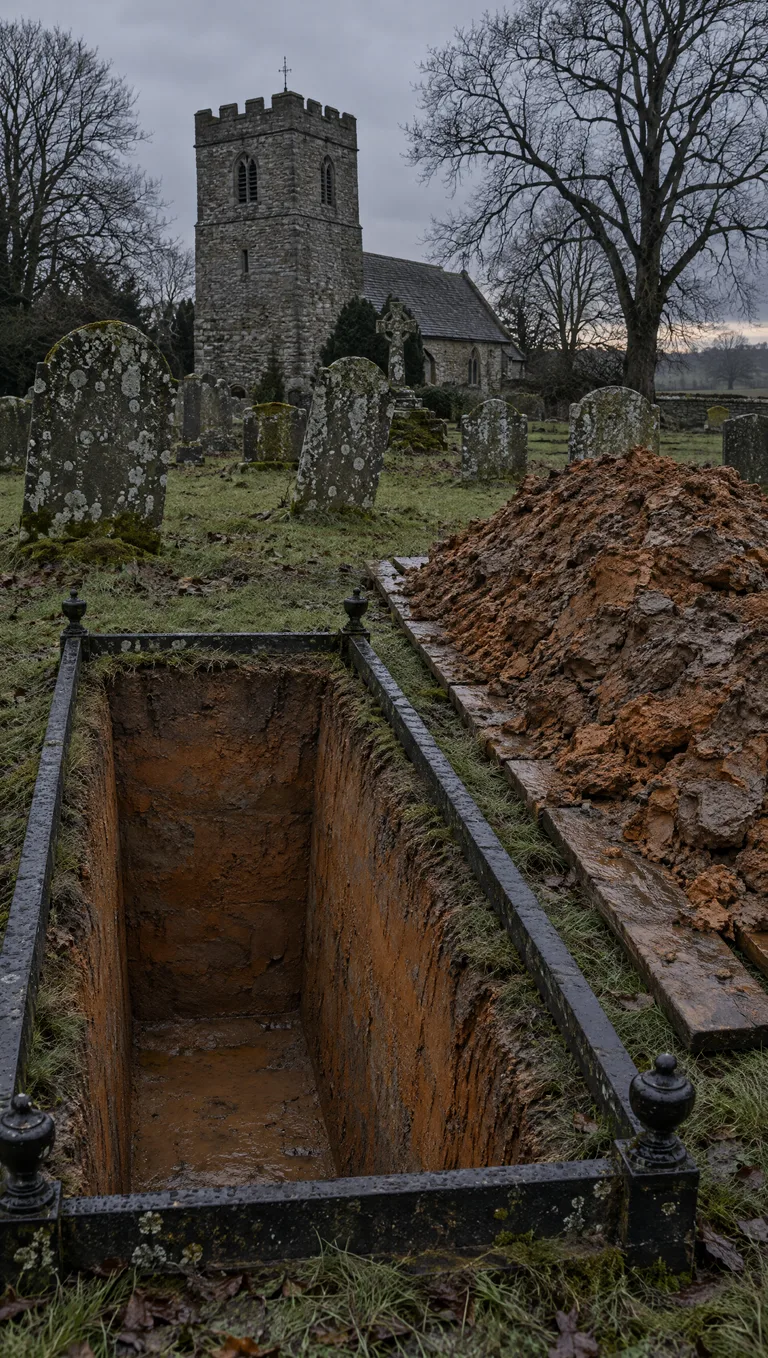
There is a grave in the churchyard at Welbury St Anne that the parish pays to have opened and refilled every seven years, and has done since at least 1878, and nobody on the council will tell you why because nobody on the council knows.
I did it four times. 1994, 2001, 2008, 2015. It is in the fabric accounts under churchyard maintenance, plot 41, made good, and the sum has been adjusted for inflation about every thirty years by somebody who clearly did not want to ask what they were adjusting.
I was the sexton there for twenty-six years. I dug one hundred and ninety-one graves and I closed two hundred and four, the difference being the ones where I was only closing for an undertaker from out of the parish. I know what a cubic yard of Welbury clay weighs wet and I know what it weighs after a fortnight in a heap, and that is the entire reason I have anything to say.
Plot 41 has no stone. It has a kerb, cast iron, with no name on it.
⁂
The instruction is written out in the vestry book and it has been copied forward by hand at least five times, each copyist reproducing the one before without comment.
Plot 41 to be opened to six feet in the seventh year, the spoil to be kept on the board, the plot to be made good the same day before dark.
That is all of it. No reason given. No prayer specified. The rector in 1994 — a decent man, nearing retirement, not given to nonsense — told me he had asked the diocese twice and been told it was a bequest condition and the paperwork was lost in a fire at the registry in 1904.
So you dig it. It takes a day. You keep the spoil on boards rather than on the grass, which is ordinary good practice for a churchyard, and you put it back before dark, which in November means you start at seven.
There is nothing in the hole. I want to be clear about that, because it is the first thing anybody asks. Six feet of Welbury clay, undisturbed below about three feet, no coffin, no bone, no void, no fill. I have opened a hundred and ninety-one graves and I know disturbed ground from undisturbed ground the way you know a cooked egg from a raw one.
Plot 41 is undisturbed. Nobody is buried in it. Nobody has ever been buried in it.
⁂
In 1994 I put the spoil back and I had some left over, and I spread it on the path, and I thought nothing at all about it, because you often do.
In 2001 I had some left over and I remembered 1994 and I thought that was mildly interesting.
In 2008 I measured.
I am not a scientist. What I did was keep the spoil on four boards instead of letting it go onto the grass, and square the heaps off with a spade, and measure them with a folding rule, and write the figures on the back of a faculty form. Then I backfilled, and compacted it the way you do, and measured what was left.
Clay from a six-foot grave bulks up by about a fifth when you break it out, and you lose most of that back when you compact. On a normal reopen I would expect to be short — to have to barrow a bit in from the spoil bay to bring it level. That is the usual way of it.
At plot 41 in 2008 I put back everything I had taken out, compacted properly, and the ground stood level, and I had four and a half cubic feet sitting on the board with nowhere to go.
Four and a half cubic feet is a wheelbarrow and a half. Out of a hole that I had filled to the top.
⁂
I did 2015 on my own, which was a mistake, and I did it properly, which was worse.
I weighed it. I borrowed a set of platform scales from the builders' merchant at Harpersford and I weighed every barrow out and every barrow in, and I wrote the figures in a book I still have.
Out: nine hundred and forty kilos. In: nine hundred and forty kilos. Standing level, before dark, as instructed. Left on the board: one hundred and seventy-one kilos.
I sat on the kerb of plot 41 in the dark with a hundred and seventy-one kilos of Welbury clay on a board beside me and I did the only arithmetic that was available, which is that the hole had taken in nine hundred and forty and was full, and that it had given up eleven hundred and eleven.
The difference does not come out of the sides. I checked the sides. Undisturbed.
⁂
I retired in 2020 and the parish has had the plot done twice more by a contractor who charges by the hour and does not weigh anything, and I have never said a word to them, and I have thought about this a great deal.
Here is where I have got to.
Everyone who has ever copied that instruction forward has assumed, as I did for twenty-one years, that the point of it is the opening. That you are letting something out, or checking on something, or honouring something.
But the instruction does not say open it. It says: the plot to be made good the same day before dark.
The opening is not the job. The opening is the price of doing the job. The job is the filling in — and whatever is down there has been fed a grave's worth of Welbury clay every seven years since before anybody living was born, and every seven years it has sent a little more back up than it was given.
It is not being buried.
It is getting closer.
 Read next
The Cutting
The rails came off the Brantwood branch in 1964. The man who walked it four times a year for thirty-four years can tell you that something is still running on it.
Get the next one first
A new horror story every week, free, straight to your inbox. Subscribers read each one before it appears anywhere else.