The Long Field
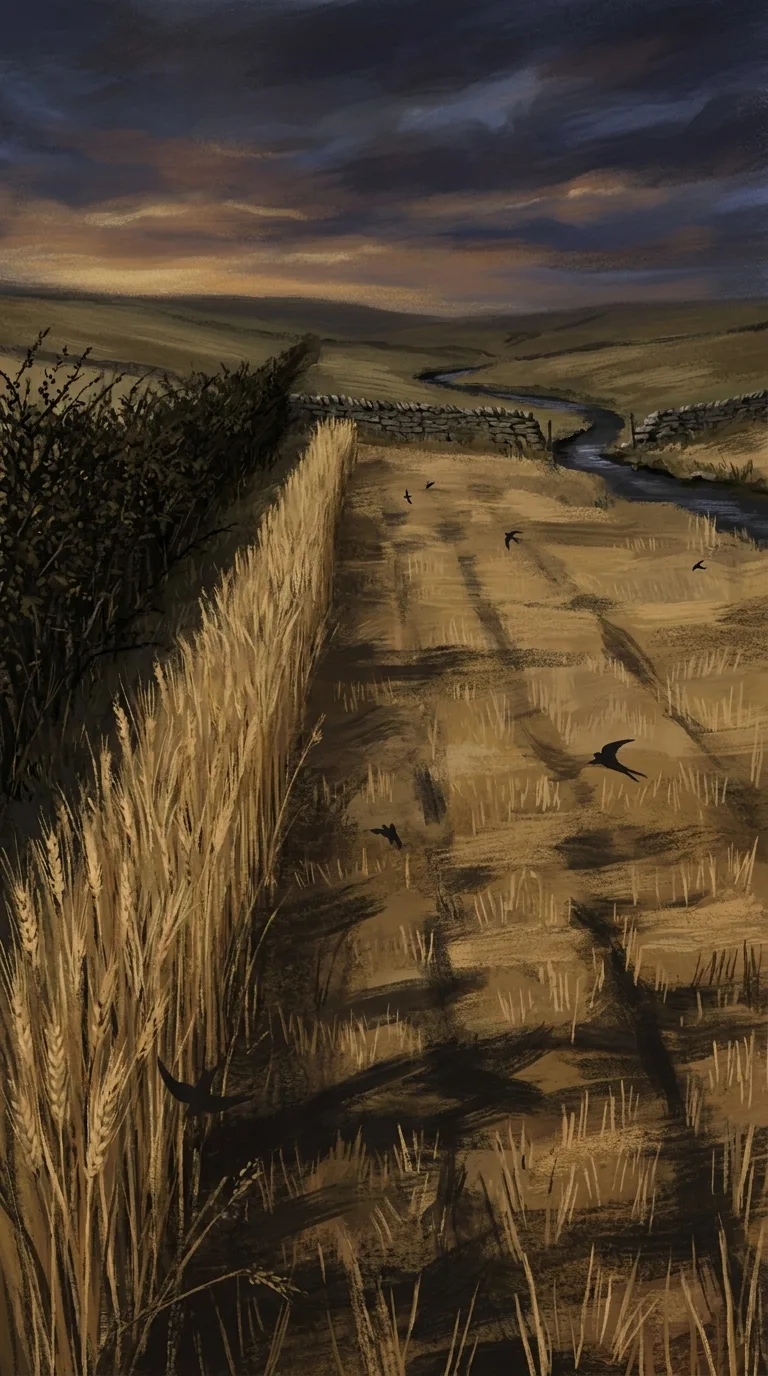
Nobody in the village would cut the last of the field, so in the end I did it myself.
I want to be fair to them. They were not unkind about it. When I took the tenancy on Bellow Farm they helped me with the fencing and they told me where the ground went soft, and when the baler broke in August three of them came out at nine at night and got it going again and would not take anything for it. They were good neighbours. They simply would not go into the long field after the middle of September, and when I asked why, they said it was how it had always been done, and changed the subject with a skill I came to admire.
The long field is eleven acres on the north side, running down to the beck. It grows barley badly and wheat worse, and the previous tenant had let it go to grass. I put it back into barley because I am stubborn and because eleven acres is eleven acres.
By the last week of September it was ready and the forecast was turning, and I could not get a single person to help me take it.
Tom Ellery, who had fixed the baler, stood at the gate with me and looked at the barley and said it was a good crop.
"It is," I said. "Will you help me get it in?"
"I'd help you with anything," he said, which was true, and he meant it, and he did not move from the gate.
---
I took it myself over two days with the old combine, and it went well, and I remember being pleased with myself in a way I am now embarrassed by. There is a particular smugness that belongs to incomers who have solved a problem the locals were too superstitious to solve. I had it badly that week. I told my sister on the phone that the whole village was frightened of a field.
On the second afternoon I came to the last of it — a strip perhaps four metres wide along the northern hedge, the part the combine could not reach cleanly because the ground fell away.
I cut it with a scythe. I am not romantic about this; I own a scythe because the corners of the yard need doing and a strimmer will not hold an edge in wet grass. It took about forty minutes. The light was going amber and the swallows were low and it was, I remember thinking, the best hour I had spent since I moved.
When I was three or four swings from the hedge, something moved ahead of me in the standing barley.
I stopped. You do stop. There are hares in the barley, and pheasant, and once a roe deer that came out of the last of a field near Wetherby and nearly took my arm off with its shoulder. So I stopped and I waited to see what it was, and I gave it a moment to run.
It did not run. It moved back — deeper into the strip, away from me, toward the hedge. Which is what an animal does. Except the strip was four metres wide and thirty long and it had been narrowing all afternoon, and whatever it was had been in there the whole time, moving ahead of the blade, keeping the standing crop between us.
I thought: it will break for the hedge.
I cut the last three swings and the strip fell and there was nothing in it.
There was no hare, no bird, no run of flattened stems where something had pushed out. The hedge was thick blackthorn and had not been disturbed. I stood in eleven acres of stubble in the last of the light and there was nowhere at all that anything could have gone.
I went home and made my tea and did not think about it, in the way you don't.
---
The knocking started in the third week of October.
Not at the door. That is the detail I have found hardest to explain to people who have not lived somewhere old — the sound was in the fabric of the house, low down, at the level of the skirting, and it moved. It would be under the kitchen window and then, a few minutes later, under the hall. Three knocks, unhurried, spaced about a second apart. Not urgent. Patient, is the word, and I have thought about that word a great deal since.
I checked for rats. I had the drains looked at. A man came from Skipton and put a camera down and found nothing and charged me two hundred pounds for the privilege, and he was decent enough to say, at the door, on his way out, that he'd had two other calls out this way over the years and never found anything either.
"Bellow Farm," he said. "This the one with the long field?"
I said it was.
He got in his van.
---
In November I went to Tom Ellery's and asked him straight, because I had run out of pride.
He put the kettle on before he answered, which I have since learned is how people here signal that a conversation is going to be a long one.
"You cut the last of it yourself," he said.
"I did."
"With a scythe."
"With a scythe."
He nodded slowly, and he looked genuinely sorry, and he said: "We don't cut it. We leave the last strip standing and we plough it in come spring."
"Why?"
And this is the thing — he did not do what people in stories do. He did not go pale, or refuse to say, or tell me some legend about a girl in 1720. He said, in the flat, practical voice of a man explaining drainage:
"Because when you cut a field you drive everything in it toward the middle. Rabbits, mice, the lot. They go in ahead of the blade and they end up in the last of the standing corn. And if you cut that last bit, they've nowhere to go but out."
"So?"
"So they come out," he said. "And they've been driven. They come out frightened and they come out toward you, because you're the thing that's been pushing them, and a frightened thing goes where the pushing came from. That's just how it works." He poured the tea. "So we leave the last strip. Everything in the field stops in it and stays in it and by spring it's gone off on its own and there's no harm done to anybody."
I said that it was only mice.
Tom Ellery said, "Aye," and drank his tea.
Then he said: "Barley's a summer crop. Field's been in grass eleven years before you took it."
I did not follow, and said so.
"Eleven years of nothing being cut," he said. "Eleven years of everything that come into that field having no reason to leave it."
---
I have been at Bellow four years now. I farm the other ninety acres and I do it well, and the long field I have left alone; it has gone back to grass and I do not go into it after the middle of September, and Tom Ellery has never once mentioned this to me, which I take as a kindness.
The knocking still comes. Less often. Autumn, mostly, and always low down, and always three, and always patient.
I have got used to it in the way you get used to anything that does not actually harm you. It has never come inside. It has never asked to.
Last Thursday my sister came to stay, and she is a light sleeper, and in the morning she asked me — carefully, the way you do when you think someone might be unwell — why I had been walking round the outside of the house at two in the morning knocking on the walls.
I told her I hadn't.
She said she knew that.
She said that was why she was asking.
 Read next
The Last Light Between Stars
The stars went out at 03:17, and Lena Vale noticed only because she had been watching them. Seven minutes later the ship was twenty-three light-years off course, and a man she had never met knew her name.
Read next
The Last Light Between Stars
The stars went out at 03:17, and Lena Vale noticed only because she had been watching them. Seven minutes later the ship was twenty-three light-years off course, and a man she had never met knew her name.
Get the next one first
A new horror story every week, free, straight to your inbox. Subscribers read each one before it appears anywhere else.