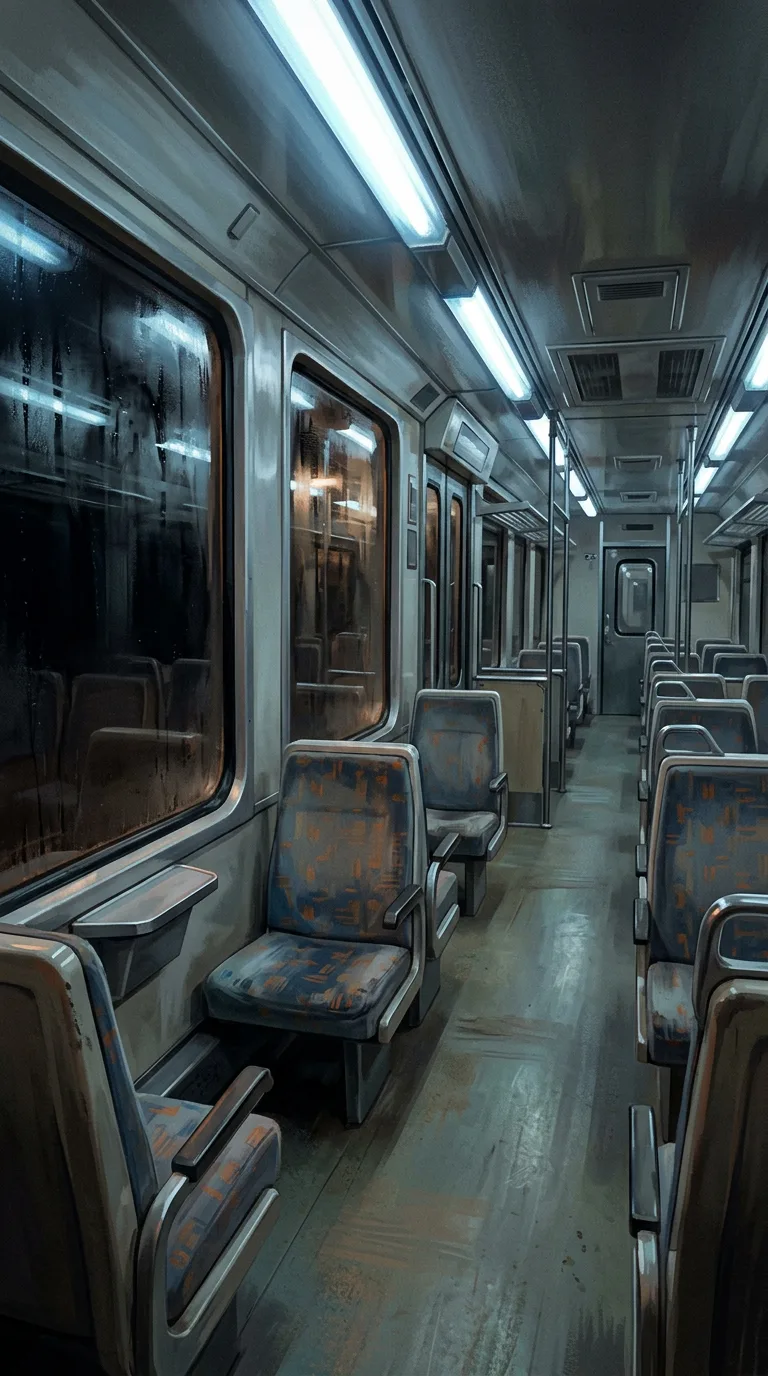
The Quiet Carriage
There are four carriages on the 23:40 and nobody talks in the third one.
This is not a rule anybody made. There is no sign. The signed quiet carriage is the first one, behind the driver, and people talk in it constantly and take calls and let their headphones leak, the way they do everywhere.
The third carriage is silent, and it is silent because everyone who uses that train knows it is, and has never discussed it with anyone, including me, until the night I am going to describe.
---
I did that commute for two years. Manchester to a small station forty minutes out, last train, four nights a week. You get to know a late-night train service the way you know a corridor in your own house — by feel, in the dark, without attending to it.
Things I knew without being told:
That the third carriage is the one that is never crowded, even when the others are.
That people getting on at Manchester will walk past it, glance in, and choose another one, and that they do this without breaking conversation, the way you step over a puddle.
That if you do sit in it, you do not talk. Not that you are shushed. You simply find that you have no particular desire to, and if the person opposite catches your eye they will give you a very small nod, the sort you give someone in a hospital waiting room.
I sat in it perhaps thirty times over two years. It is a good place to think. I liked it.
---
The rule — the one nobody says out loud — is that you do not sit in it twice in the same week.
I did not know this. I want to be clear that I did not know this, because otherwise what follows sounds like recklessness rather than what it was, which was ordinary ignorance.
I found out on a Thursday in November, from a woman I had seen perhaps a hundred times and never spoken to. Fifties, tired, worked in a hospital by the look of the lanyard she never took off.
I got on at Manchester and turned into the third carriage and she was already sitting there, and when she saw me she stood up.
She came down the aisle and stopped beside my seat and said, very quietly, "You were in here Tuesday."
I said that I supposed I had been.
"Not twice," she said. "Not in the same week."
I did what anybody would do. I said, more loudly than I meant to, "Why?"
And she flinched — properly flinched, the whole body — and looked down the carriage, and then she sat down across the aisle from me and put her bag on her lap and did not answer for about a minute.
Then she said: "Because it counts."
---
Here is what she told me, in a low voice, over about twelve minutes, between two stations.
She had done that train for nineteen years. Her mother had done it before her, from the same station, when the rolling stock was different and the third carriage was a different carriage, and the same thing had been true of it.
That there is nothing wrong with the carriage. That she wanted to be clear about that. She had never seen anything in it and neither had anybody else she had ever spoken to, and she had spoken to perhaps six people about it in nineteen years and every one of those conversations had gone the way ours was going.
That the carriage is simply attentive. That is the word she used. She said it the way you would describe a room with good acoustics — not sinister, just a property of the space.
"It notices who's in it," she said. "Once a week, it doesn't matter. You're one of forty people that week and it doesn't know you from anybody. Twice, and it starts to think you're something to do with it."
I said: "That's not — that isn't a thing that can be true."
"No," she agreed. "And I've never once been able to explain it, and I've stopped trying, and I still get off at Greenfield and I have never sat in there twice in nineteen years and neither did my mother."
The train slowed. She stood up to get off.
And then she said the only part of this that I have not been able to put down.
"You'll be fine. Almost everybody's fine. Just — don't do it a third time this week, and if you find yourself walking into it anyway, get off at the next stop even if it's the wrong one."
"Why would I walk into it anyway?"
She said, "Because it's a very comfortable carriage," and got off.
---
I did the sensible thing on the Friday. I got on at Manchester and I walked straight past the third carriage into the fourth, which was full of a stag do, and I stood the whole way with somebody's rucksack in my back and I felt like a rational adult who had been briefly taken in by a stranger.
The following Tuesday I sat in the third carriage, because it was Tuesday, and one a week is fine.
And on the Wednesday — not Thursday, Wednesday, one day later — I got on the 23:40 exhausted after a bad shift, and I walked down the platform, and I got into the third carriage and sat down and had my coat off and my bag under the seat before I understood what I had done.
I had not decided to. I want to be exact about this, because it is the only genuinely frightening thing that has ever happened to me. There was no moment of choosing. I was on the platform and then I was sitting down, and the intervening thirty seconds are not missing — I remember walking, I remember the doors, I remember the smell of the heater — they simply do not contain a decision.
The carriage was empty.
I got off at the next stop. It was the wrong stop, eleven miles from my house, and I paid forty pounds for a taxi and I did not look back at the train as it pulled out.
---
I changed jobs the following spring, for other reasons, and I have not been on that line since.
I have told this to four people. Two of them laughed, which was fair. One asked, reasonably, whether I had simply been very tired, and I said yes, probably.
The fourth was a man I used to work with who had grown up in Rochdale, and he did not laugh or ask anything. He listened all the way to the end and then he said, "Which one was the third one — from the front or the back?"
I said I had never actually thought about it. That I had always just known which one it was.
And he nodded slowly and said, "Yeah," and changed the subject, and would not come back to it, not that night and not ever.
 Read next
Low Tide
You have three hours to cross the causeway and you must not be on the sand when the tide turns. Nobody explains why it matters more on the way back.
Read next
Low Tide
You have three hours to cross the causeway and you must not be on the sand when the tide turns. Nobody explains why it matters more on the way back.
Get the next one first
A new horror story every week, free, straight to your inbox. Subscribers read each one before it appears anywhere else.